
Code Scanner — Standalone Usage
Run the CoreFix code scanner on any machine with Docker installed using the corefix CLI. It runs the corefixhq/cfix image for you — no docker run commands, volume mounts or environment variables to manage.
Check your installed version with corefix --version, and pull the latest scanner images with corefix update.
New Scanners Now Live
- Container Scanning - vulnerabilities in your container images
- CIS Benchmarking for Dockerfiles
- Malware & Supply Chain Risk Detection for packages
- SonarQube Integration for security hotspots, code smells, and bugs
- AI Governance Scanner and AI BOM — AI Bill of Materials and governance scan across source code
- SBOM Generator — Software Bill of Materials for your project
Setup
You need Docker running and the corefix binary on your PATH. See CoreFix CLI — Overview for installation.
Log in
corefix loginThis opens your browser, signs you in to CoreFix, and saves your session to ~/.corefix/session.json. One login covers both code and web scanning, and you only do it once per machine.
Alternatively, skip the login and export an API key. See Creating an API Key:
export CFIX_API_KEY=<your-api-key>corefix reads ~/.corefix/session.json first and falls back to $CFIX_API_KEY.
Update the scanner images
corefix updateDocker Hub: hub.docker.com/r/corefixhq/cfix
Quick Start
Run from the root of the repository you want to scan:
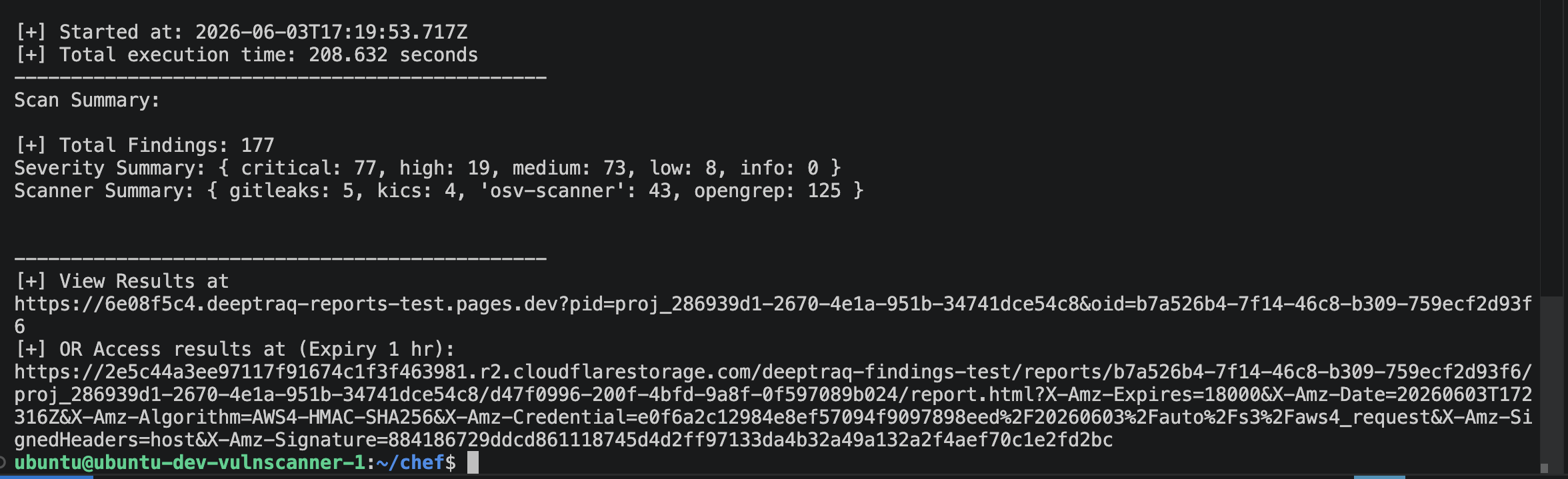
corefix codeThat's it — all scanners run against the current checkout, and results are written to ~/.corefix/scan-results and sent to your CoreFix dashboard.
Full Command Reference
corefix code [<scanner>[,<scanner>...]] \
  [--openai-api-key <key>] \
  [--model <model-name>] \
  [--ignore-ai-analysis] \
  [--container <images>] \
  [--patch] \
  [--rescan] \
  [--pr] \
[--sarif]Other commands:
| Command | Description |
|---|---|
corefix login | Log in to CoreFix using your browser. Covers both code and web scanning |
corefix code status | Print the last known scan status (branch, commit and patch state) as JSON |
Authentication and Output
| Item | Description |
|---|---|
| API key | Read from ~/.corefix/session.json (created by corefix login), falling back to the CFIX_API_KEY environment variable |
| Source code | corefix scans the repository in your current directory. Run it from your repository root |
| Results | Reports are written to ~/.corefix/scan-results after the scan completes |
What corefix code does for you
You don't pass any Docker flags — corefix code sets up the container for you:
- Runs as your user. The scanner container always runs with
--user "$(id -u):$(id -g)", so files it writes are owned by you rather than root. - Mounts
$HOME/.corefixautomatically. This is how the scanner is authenticated with yourcorefix loginsession, and where results are written. - Mounts the Docker socket only for container scans. When
--containeris used,-v /var/run/docker.sock:/var/run/docker.sockis added so the scanner can access your local Docker daemon and pull images directly — no credentials to your container registry are needed.
Scanners
Pass a comma-separated list as the first argument. Defaults to all scanners if omitted: osv,iac,secrets,k8s,sast,sonar,container,ai,malware
| Value | Tool | What it finds |
|---|---|---|
sast | OpenGrep | Code vulnerabilities across 30+ languages |
secrets | Gitleaks | Hardcoded credentials, API keys, tokens |
osv | OSV-Scanner | Dependency CVEs with reachability analysis |
iac | KICS | Terraform, Dockerfile, Helm, CloudFormation misconfigs |
k8s | Kubescape | Kubernetes RBAC, pod security, CIS benchmarks |
sonar | SonarQube | Security hotspot, bug, code smell, and vulnerability rules |
container | CoreFix Container Scanner | Container image vulnerabilities and Dockerfile CIS benchmarking |
ai | AI BOM / AI Governance Scanner | AI Bill of Materials (AI BOM) and AI governance scan across source code |
malware | CoreFix Malware Scanner | Malware within Python, NPM (JS), Golang, Ruby gems, GitHub Actions, and VS Code extensions, plus cross-package supply chain risk detection |
Automatic SBOM Generation
On your main branch, an SBOM is generated automatically by default — there is no sbom scanner to pass yourself.
- A full source-code SBOM is generated from a directory scan of your entire repository.
- If any images are passed via
--container, or taggedcfix, a container SBOM is generated automatically for each of those images. - If the
aiscanner is included in the run, an AI Bill of Materials (AI BOM) is also generated alongside the source SBOM.
CodeFix — Automated Remediation
For the full reference — patch options, patch limits by plan, and how patching behaves when your branch or commit diverges from the scanned snapshot — see CodeFix — Automated Remediation.
CoreFix can patch the vulnerabilities it finds instead of just reporting them. --patch runs CodeFix against your findings and writes the fixes into your repository.
OpenCode Agent Included
CodeFix uses the OpenCode coding agent, which ships by default inside the CoreFix Docker image — there is nothing to install or configure. In the future, you will also be able to use your own Claude or Codex as the coding agent.
How the Pull Request Gets Made
--pr defaults to true if the GitHub App is installed, false otherwise. See Opening a Pull Request for how CoreFix authenticates.
# Fix the previous pending scan (or scan and fix if none is pending)
corefix code --patch

# Apply fixes and open a pull request automatically
corefix code --patch --prAI Models
CoreFix automatically selects an AI model for enrichment based on your account. You don't need to configure anything — but you can override if needed.
If you don't specify a model or API key:
- Open source plan → a standard model is randomly selected from the open source pool
- Paid plan → a premium model is randomly selected for higher quality enrichment
If you specify --model without --openai-api-key:
- Paid plan → that model is used if supported
- Open source plan → the model flag is silently ignored and a standard model is selected
If you specify --openai-api-key:
--modelis required. The scan will fail without it.- The specified model is used via your key. You pay your provider directly.
- See Supported Models → for the full list of models available with BYOK.
# BYOK — must include --model
--openai-api-key sk-proj-xxxxxxxx --model gpt-5-miniModels accepted by --model for code scans: gpt-5-mini, gpt-5.4-mini, gpt-5.6-luna, bedrock:runtime:claude-haiku-4.5, claude-haiku-4.5, gpt-5, gpt-5.4, gpt-5.6-terra, claude-sonnet-4.6, claude-sonnet-5
Skip AI analysis entirely:
Pass --ignore-ai-analysis to skip the AI pipeline — this covers deduplication, enrichment of findings, and AI-based prioritization. Raw and normalized findings are still written to ~/.corefix/scan-results, but no enriched report or AI-based prioritization is generated.
CLI Options
--openai-api-key (optional)
Your own OpenAI API key. Requires --model. See AI Models above.
--model (optional)
Override the AI model used for enrichment. See AI Models for the accepted values and Supported Models.
--ignore-ai-analysis (optional)
Skip the AI pipeline — deduplication, enrichment of findings, and AI-based prioritization are all skipped. Useful for faster runs, or when you only need raw/normalized findings without AI enrichment. Cannot be combined meaningfully with --openai-api-key / --model, since there is no enrichment step to run those against. Default: false.
--container (optional)
Comma-separated list of container images to scan. See Container Scanning for the full reference, CI/CD example, and the cfix-tag opt-in.
--container nginx,redis:v6.2.0,postgres:latest--patch (optional)
Fix the previous pending scan, or scan and fix when no pending scan exists. Fixes are applied in an isolated worktree. Patches always apply to the snapshot (branch and commit) of the previous scan — see Scan snapshots and re-runs. On the Free plan, up to 5 patches (5 commits) are applied at a time; Pro and Teams fix all issues in all files in one go — see Patch limits by plan. Default: false.
--patch--rescan (optional)
Scan the current checkout again; add --patch to also fix findings. Use it when CoreFix reports that your branch or commit has changed since the previous scan. On its own, --rescan is a security scan only. Default: false.
--rescan --patch--pr (optional)
Open a pull request after remediation, with inline review comments added to the code explaining the vulnerabilities that were fixed. No --github-token needed. Defaults to true if the GitHub App is installed — otherwise defaults to false and must be passed explicitly. See Opening a Pull Request for how CoreFix authenticates to GitHub.
--patch --pr--sarif (optional)
Push the scan results as a SARIF file to your repository's GitHub Code Scanning (Security tab). Authenticates the same way as --pr — a GitHub App token automatically if the app is installed, otherwise your local gh login — see Opening a Pull Request. Default: false.
--sarifWARNING
Commit must exist on GitHub: --sarif only works if the scanned commit has already been pushed to GitHub. If it hasn't, the push fails with commit not found.
Code Security must be enabled for private repos: SARIF uploads work out of the box on public/open-source repositories. On a private repository, GitHub requires Code Security (GitHub Advanced Security) to be enabled before it will accept a SARIF upload — and that's only available on GitHub Team or Enterprise; on GitHub Free or Pro, Code Security isn't available for private repos at all, so --sarif won't work there. If it isn't enabled, the push fails with:
Advanced Security must be enabled for this repository to use code scanningIf you're on a plan that supports it, enable it per repository:
- Go to Settings → Security → Code security and analysis in your GitHub repository.
- Find Code scanning (or GitHub Code Security) and enable it.
Examples
All scanners
corefix codeSpecific scanners only
# Secrets and SAST
corefix code secrets,sast

# Dependencies and IaC only
corefix code osv,iac

# Sonar, AI BOM/Governance, and malware scanning
corefix code sonar,ai,malwareBring your own API key
corefix code \
  --openai-api-key sk-proj-xxxxxxxx \
--model gpt-5-miniSkip AI analysis
corefix code --ignore-ai-analysisContainer scanning
See Container Scanning for the --container reference, the cfix-tag opt-in, and a CI/CD example that scans an image right after it's built.
Upload results to GitHub Code Scanning
corefix code --sarif- Example of Logs showing successful sarif upload.
[*] Uploading 51 findings to GitHub...
[*] Repo: chef Branch: main Commit: d1e9ce21e1f7925b9c489aa137ffd57bb788b87f
[+] SARIF accepted. Status URL: https://api.github.com/repos/mai1x9/chef/code-scanning/sarifs/e98d6b64-5f70-11f1-9ac1-06c8a1baee39
[*] SARIF processing status: complete
[+] SARIF processing complete. Errors: []
[+] SARIF uploaded to GitHub Security tab
https://github.com/mai1x9/chef/security/code-scanningFull example with all options
corefix code secrets,sast,osv \
  --sarif \
  --openai-api-key sk-proj-xxxxxxxx \
--model gpt-5-miniAutomated remediation with CodeFix
# Fix the previous pending scan (or scan and fix if none is pending)
corefix code --patch

# Apply fixes and open a pull request
corefix code --patch --pr

# Re-scan the current checkout, then fix and open a PR
corefix code --rescan --patch --prUse in scripts and CI
export CFIX_API_KEY=<your-api-key>
corefix code --ignore-ai-analysis

# Read the last known scan / patch state as JSON
corefix code status | jq .